english × ai immersion camp, weekend

Weekend English × AI Camp

For two days, children spend time with staff in English only. They use AI to build their own English study system, use it, and take a practice test at the end to see how much they improved.

First campNov 14 (Sat) – Nov 15 (Sun)Applications closedNov 28 has a Thanksgiving theme
Elementary and junior high school students1 night, 2 days / Day tripFormer Kanzaki Elementary School (Sanuki City, Kagawa)
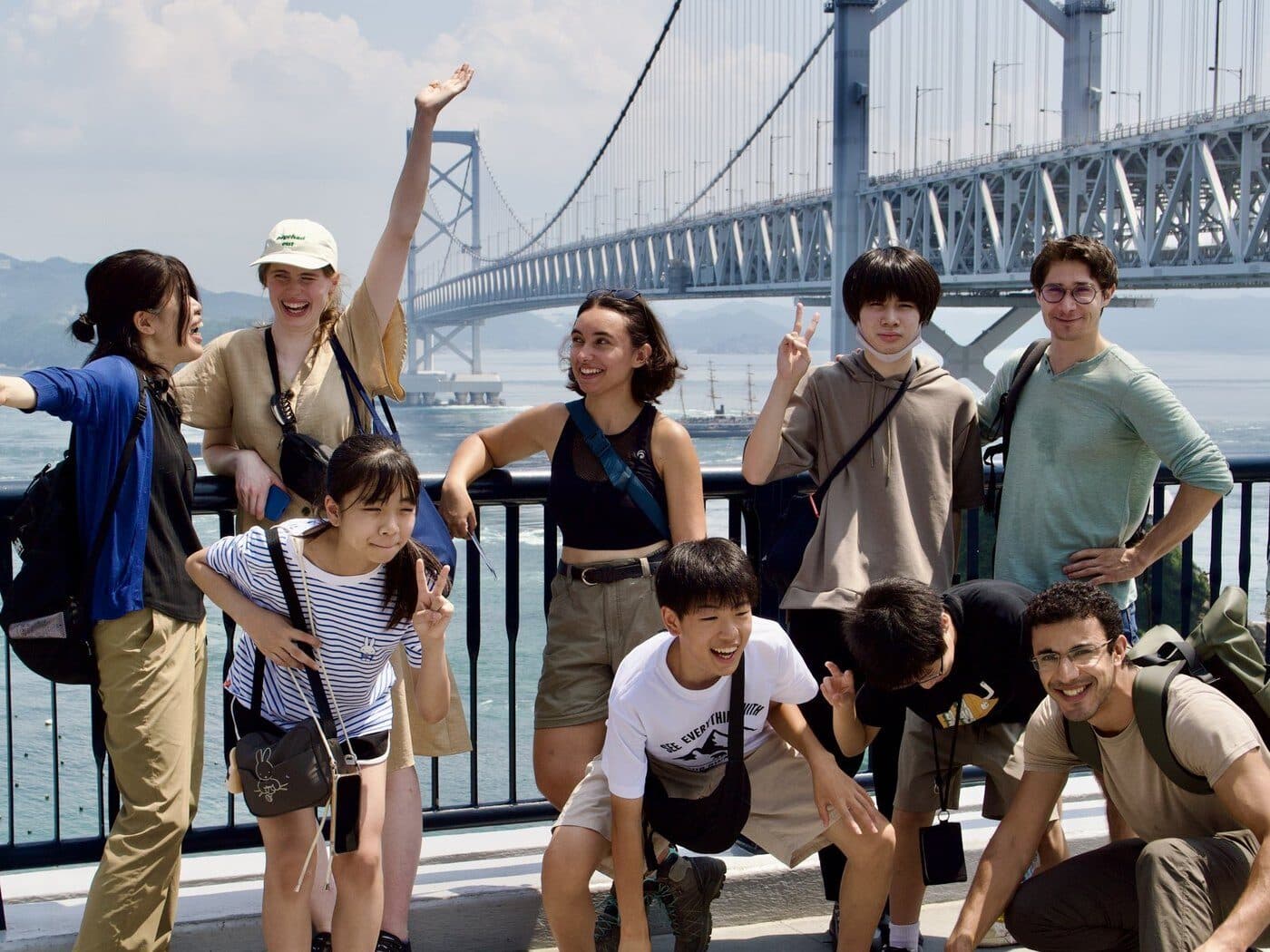
Staff and children smiling together in front of a bridge

what children learn

Three skills your child builds

Most English camps aim to help children use English. This camp goes one step further. Children use English, and they learn to use AI to build their own way of learning.

ENGLISH

Living in English

  • Everything is in English, from meals to games to greetings
  • Ask again in English when you do not understand
  • Follow instructions given in English
  • Give a short talk in English at the end
AI

Learning with AI

  • Ask AI good questions (prompts) in English
  • Make your own word cards, quizzes, and study plan
  • Check whether the AI's answer is correct
  • Follow safe rules, such as never entering personal information
TEST

Testing yourself

  • Set a goal (an Eiken grade, a school test, and so on)
  • Review the questions you got wrong
  • A short quiz in the same format at the start and end of camp
  • See your own progress with your own eyes

english, by level

What children learn in English

On day 1, children take a short check and join a group that fits their level. Each camp has a theme, and children use the words and phrases for that theme (Nov 28 is Thanksgiving).

Elementary school

Speak
Greetings, self-introductions, and requests and questions such as "Can I …?" and "What is this?"
Listen
Follow English instructions in games and cooking
Words
About 30 words for the theme. Practice on your own with cards and quizzes
Present
Give your friends a quiz you made yourself, in English
Level
Words and phrases for Eiken Grade 5 to 4 (Eiken is a Japanese English test)

Junior high school

Speak
Give an opinion with a reason. Keep up an everyday conversation with staff
Write
Write your requests (prompts) to AI in English
Read
Read the AI's English answers and decide if they are correct
Present
Introduce your own study system in English, in 1 to 2 minutes
Level
Words and grammar for Eiken Grade 4 to Pre-2

Eiken grades are only a rough guide for practice. We do not promise that your child will pass.

ai, step by step

Build your own study system with AI

Children do not just ask AI for answers. They learn to use AI to build a system that helps them remember. There are four steps.

  1. 1

    Build

    Tell the AI your goal and what you like, in English. Make word cards, quizzes, and a daily study plan.

  2. 2

    Practice

    Practice with the quizzes you made. When you are stuck, ask the AI in English.

  3. 3

    Check

    Review the questions you got wrong. Compare the AI's answers with a dictionary and with staff.

  4. 4

    Test

    Take a practice test at the end. Compare it with the first quiz to see how much you improved.

What is AI?

AI is a tool that writes text by predicting which words come next. It is useful, but it can be wrong. We start from that idea.

How to write a good question (prompt)

Tell the AI what you want, at what level, and in what form. Do it in English.

Make 10 quiz questions with EIKEN Grade 4 words about Thanksgiving. Give 4 choices for each.

Review before you forget

Words stay in your memory when you review them several times, with time in between. Each child's system includes a review list that shows the questions they got wrong first.

Check the AI's answers

Children play a game of finding the mistakes in AI answers. They get into the habit of checking with a dictionary, a textbook, and staff.

Use AI safely and responsibly

Never enter personal information such as your name, school, or photos. Do not hand your homework to AI. Children use AI only on devices and accounts that staff set up.

Methods for adults, made for children

PLH teaches executives to build their own tools with AI in the AI Native Management Retreat. We adapted that method for children.

The guidelines on generative AI in primary and secondary education (Ver. 2.0, December 2024) from Japan's Ministry of Education (MEXT) give examples such as using generative AI as an English conversation partner and to make word lists. They also describe learning to check whether information is true.

example

Example: Maru, an exam-prep app made with AI

Lucce, General Manager of PLH Sanuki, made this study app with AI to pass a Japanese language exam. At camp, children build a smaller system like this one for their own goal, such as Eiken.
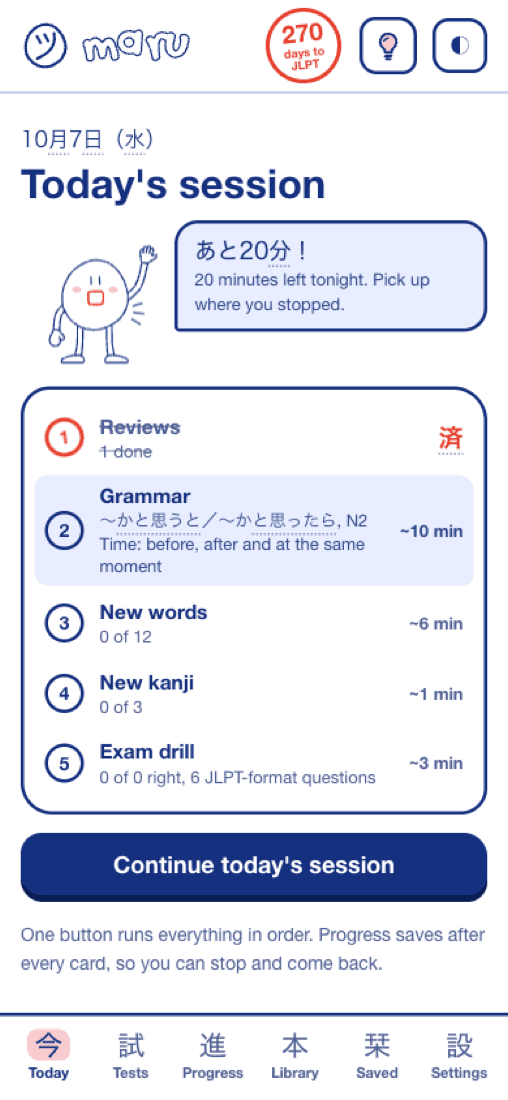
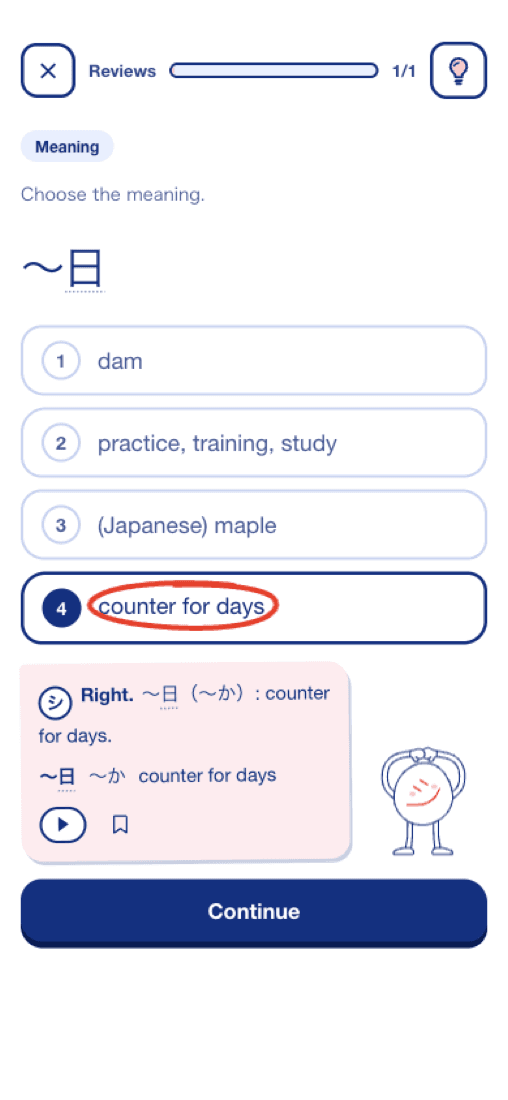
  • Daily planToday's tasks appear as a menu of about 20 minutes
  • ReviewWords you are about to forget come back at the right time
  • QuizAnswer a 4-choice question and see the correct answer and an explanation right away
  • Mock testCheck your skills in the same format and time as the real test
The Maru app. Today's study menu: review, grammar, new words, new kanji, and exam-style questions
The Maru quiz screen. A correct answer gets a red circle and an explanation

Real screens. Left: today's study menu. Right: a correct answer in the quiz.

two days, an example

The two days (an example for the 1-night camp)

Times and activities change with each camp's theme and the number of children. Day-trip children join day 1 (10:00 to 17:00).

Day 1 (Sat)

10:00Meet up. Explain the "English only" rule. Self-introduction game
10:45First quiz, and a warm-up with the theme words
11:30What is AI? Rules for using AI
12:30Lunch (order and talk in English)
13:30AI project 1: Set a goal. Ask the AI in English to make word cards and quizzes
15:00Outdoor play and activities (with instructions in English)
16:15AI project 2: Put a daily plan and a review list together into your own study system
18:00Cook dinner (in English)
19:30Theme event (Nov 28: Thanksgiving games)
21:00Bath and getting ready for bed

Day 2 (Sun)

7:30Wake up and breakfast
8:45Morning review: review yesterday's words with your own system
9:30AI project 3: Find the mistakes in AI answers and fix your system
11:00Practice test (same format as the first quiz)
12:00Lunch
13:00Show and tell: introduce your study system in English
14:30Feedback for parents and certificates
15:00End of camp

AI time (everything is in English)

Group photo of an English classChildren playing an English word game at a deskChildren working on a computerPlaying outside on the schoolyardCooking timeEveryone eating udon for lunch

what they take home

What children take home

  • Their own English study system, in a form they can keep using at home
  • The results of the first quiz and the practice test
  • A checklist of what they can now do in English
  • A certificate of completion

safety

Safety

  • At least 1 adult staff member for every 5 children
  • On overnight stays, female staff stay with the children
  • Children use AI only on devices and accounts that staff set up, and staff watch how they use it
  • We ask about allergies and meal needs when you apply
  • Overnight stays are at Shawn House, PLH's lodging facility, which has a license under Japan's Inns and Hotels Act (up to 4 children per camp; if the rooms are full, your child can join as a day participant for the same fee)

dates & fees

Dates and fees

Nov 14–15First camp, Sat–SunApplications closed
Nov 28–29Thanksgiving, Sat–SunApplications closed
Dec 5–6Sat–Sun
Jan 23–24Sat–Sun
Feb 27–28Sat–Sun
1 night, 2 days¥44,000tax included
Day trip (day 1 only)¥14,300tax included

Prices are per child. They include lodging (if your child stays overnight), meals, activities, and materials. There is also a winter break camp (Dec 26–30, 4 nights 5 days, ¥86,900) and a spring break camp (Mar 27–Apr 2, 6 nights 7 days, ¥104,500, or Mar 27–31, 4 nights 5 days, ¥86,900). All prices include tax.

payment & cancellation

Payment and cancellation

This is an English translation for convenience. The Japanese page is the official text.

  • Sending the form is an application to join. Your place is confirmed when we (vKirirom Japan Inc.) send you a confirmation email ("acceptance confirmation").
  • Fees (per child, tax included): 1 night 2 days ¥44,000 / day trip ¥14,300 / 4 nights 5 days (Dec 26–30, Mar 27–31) ¥86,900 / 6 nights 7 days (Mar 27–Apr 2) ¥104,500. Fees include lodging (if your child stays overnight), meals, activities, and materials. There are no other charges when you pay.
  • Overnight places are limited to 4 children per camp, in the order we confirm places (room allocation may make it fewer). If they are full, we will offer a day place. The fee is the same (for 1-night weekend camps, you can also choose the ¥14,300 day trip on the first day only).
  • Dates: Weekends Nov 14–15, Nov 28–29, Dec 5–6, Jan 23–24, Feb 27–28 (1 night 2 days or day trip) / Winter Dec 26–30 (4 nights 5 days) / Spring Mar 27–31 (4 nights 5 days), Mar 27–Apr 2 (6 nights 7 days).
  • Application deadline: up to 8 days before the start date of each camp.
  • Payment: Pay the full amount by credit card, using the payment link (Stripe) that we send by email. Pay within 7 days after we confirm your place, and no later than 7 days before the start date, whichever comes first. We do not accept cash or bank transfer. If you cancel before you pay, or if we do not receive payment by the deadline, we treat your application as canceled. There is no charge.
  • Cancellation (based on the start date, which is the first day of each camp): up to 8 days before = we refund the fee minus an amount equal to the payment processing fee (3.96%) / 7 days to 2 days before = we refund the fee minus 30% / the day before = we refund the fee minus 40% / the day of the camp or no-shows without notice = we refund the fee minus 80% / leaving early for personal reasons = we refund the fee for the remaining days (fee ÷ number of camp days × remaining days, counted from the day after your child leaves) minus 80% of that amount. When 30%, 40% or 80% is deducted, the payment processing fee is not deducted separately. Contact sanuki@plh.life or call 0879-43-0311 (+81 879-43-0311 from abroad).
  • The minimum is 4 children per camp. We decide 8 days before the start date. If there are fewer than 4, we cancel the camp and refund the full fee. We tell you by email no later than 7 days before the start date. If we cancel for our own reasons or because of weather, we also refund the full fee.
  • For details, see the Legal notice under the Act on Specified Commercial Transactions (English × AI Camp) (in Japanese).

questions

Questions and answers

Is it OK if my child hardly speaks English?

Yes. Children join groups by level, and staff use gestures and pictures. The first goal is to be able to say "I don't understand" in English.

Do we need a computer or a smartphone?

No. Staff provide the devices and accounts for using AI.

Is AI too early for elementary school children?

We do not let AI give the answers. We teach children to find AI's mistakes and to follow rules for using it well. Staff watch how children use it.

Can my child keep studying at home after camp?

Yes. Children take home the study system they made, so they can keep using it at home. We explain how to keep going in the final review.

What kind of staff will be there?

Staff from many countries spend the camp with the children in English. PLH's AI staff lead the AI sessions.

Apply

Choose your dates in the application form and apply. After you send the form, PLH Sanuki will contact you by email. That email confirms your place. Applications for the Nov 14–15 and Nov 28–29 camps are closed.


Go to the application form